

To hire and sponsor employees in the UAE, foreign branches must secure a valid trade license and comply with local labor laws. You'll need to guarantee that candidates meet specific eligibility criteria, including professional qualifications and medical fitness tests. The work visa application entails obtaining Entry Visa Quota Approval, along with required documentation such as employment contracts and proof of qualifications. Additionally, you must maintain adherence to payroll regulations via the Wage Protection System and fulfill your responsibilities regarding health insurance and employee benefits. Following these guidelines systematically will enhance your understanding of the intricate sponsorship process.
Business Licensing Requirements

To sponsor employees in the UAE, you must first secure a valid trade license from the relevant authorities. This business license serves as the foundation for your employee sponsorship endeavors, ensuring adherence to the UAE's regulatory framework. Before applying for sponsorship, your business must be established and licensed, demonstrating compliance with local regulations. You'll need to provide documentation verifying your business's legal status, operational activities, and conformity to safety standards. Additionally, be aware that the licensing process includes inspections of your premises to confirm compliance. It's essential that your business license remains free of violations; any non-compliance can result in penalties or rejection of your employee sponsorship applications, jeopardizing your operational capabilities in the region. Furthermore, securing the correct type of business license type is crucial for ensuring smooth operations and legal compliance.
Eligibility Criteria for Workers
When considering employment in the UAE, you'll need to meet specific eligibility criteria that guarantee your qualifications align with the job requirements. First and foremost, you must be at least 18 years old and possess the necessary professional skills or academic credentials relevant to your role. Additionally, your assigned profession should correspond with your employer's business activities, and you must ascertain compliance with residency regulations, including a medical fitness test for visa approval. Furthermore, it is essential to understand the visa validity checks to avoid fines and legal issues during your employment.
Professional Qualifications Required
In the UAE, employers must guarantee their workers have the right professional qualifications for the positions they're being sponsored for. This includes holding a recognized academic degree or relevant professional certification that aligns with the job's requirements. The Ministry of Human Resources and Emiratisation mandates that employers provide documentation verifying these qualifications during the sponsorship process. All professional qualifications must be attested and recognized by the appropriate authorities in the UAE to confirm compliance with local regulations. Failure to meet these criteria may jeopardize the issuance of a work permit, making it imperative for foreign branches to thoroughly assess and validate their employees' qualifications before initiating sponsorship procedures. Proper adherence confirms a smooth and lawful hiring process. Additionally, engaging with experienced business setup services can further streamline the hiring and sponsorship process for foreign branches.
Age and Residency Criteria
For workers seeking employment in the UAE, meeting specific age and residency criteria is vital. To guarantee eligibility, consider the following requirements:
- You must be at least 18 years old to qualify for employment.
- A valid residency permit is mandatory for foreign employees, secured through sponsorship by a UAE-based entity.
- You must possess the necessary professional competence or academic qualifications relevant to your job role.
- You cannot hold a valid work permit from another company while being sponsored by a new employer.
Compliance with these age and residency criteria is essential for foreign workers wishing to work in the UAE. Adhering to these regulations not only facilitates a smoother shift but also guarantees legal standing within the emirates.
Licensing and Registration Process

How can a foreign branch effectively navigate the licensing and registration process in the UAE? First, you'll need to secure a valid trade license from the UAE's Ministry of Economy or the relevant free zone authority, which is indispensable for legal operation and sponsoring employees. The licensing process requires submitting documents such as proof of the parent company's registration and a detailed business plan for approval. Additionally, maintaining a physical office space is essential, as it directly influences the number of employee visas your branch can apply for. Compliance with local regulations, including obtaining the Establishment Card, is crucial before you can initiate the employee sponsorship process, which may vary based on the jurisdiction's specific requirements. Establishing a branch (with the necessary local service agent) can streamline the process and enhance your operational capabilities in the UAE.
Work Visa Application Steps
Once you've secured your trade license and established your branch in the UAE, the next step is to navigate the work visa application process. Here's a concise outline to guide you:
- Obtain Entry Visa Quota Approval from the Ministry of Human Resources and Emiratisation (MoHRE).
- The employer must submit a signed and translated job contract in the required languages as part of the visa application.
- After acquiring the work permit, the employee receives an entry visa, allowing them to enter the UAE, followed by obtaining an Emirates ID.
- Verify the applicant passes a medical fitness test and provides proof of health insurance, as these are mandatory requirements for the work visa application.
Adhering to these steps guarantees compliance with UAE labor laws and facilitates a smooth hiring process.
Standard Employment Contract Details

When creating a standard employment contract in the UAE, it is vital to follow the mandated format set by the Ministry of Human Resources and Emiratisation. The contract must clearly outline key details, including the names of both parties, start date, salary, working hours, vacation leave entitlement, and the notice period for termination. As an employer in the UAE, you must guarantee that any additional clauses comply with legal requirements and receive prior approval from the Ministry. Contracts are available in 11 languages, promoting clarity for your diverse workforce. Remember, failure to submit accurate data in the employment contract can lead to significant penalties, including fines of up to AED 20,000, so meticulous attention to detail is imperative when drafting for an employment visa.
Required Documentation
To successfully sponsor employees in the UAE, you'll need to gather several essential documents. The required documentation for a work permit application is crucial for employers to guarantee compliance and avoid delays. Here's what you need:
- A valid business license.
- An eSignature card for authorized signatories.
- The worker's passport along with relevant academic qualifications.
- Signed and translated job contracts in the required languages.
In addition, a bank guarantee of AED 3,000 per employee is necessary, plus any applicable fees. Remember, adherence to the Wages Protection System is mandatory, as incorrect documentation can lead to refusal or cancellation of permits. Being thorough and accurate in your submission is significant for a smooth hiring process.
Types of Work Permits

Maneuvering the landscape of work permits in the UAE can be essential for employers and employees alike. The Ministry of Human Resources and Emiratisation (MoHRE) issues 12 types of work permits tailored to various employment needs. Standard work permits are the most prevalent, requiring initial approval from MoHRE, an entry visa, a medical fitness test, and an Emirates ID application. Alternatively, sector-specific permits cater to high-demand fields such as healthcare and education, necessitating specific qualifications and relevant authority approvals. Furthermore, Special Economic Zone (SEZ) permits offer advantages like tax exemptions and 100% foreign ownership, featuring streamlined application processes for eligible roles. Remember, all employment visas must adhere to age criteria and may require attested educational certificates for certain positions.
Employee Quota Determination
Determining the employee quota for foreign branches in the UAE involves a careful assessment by the Ministry of Human Resources and Emiratisation, taking into account your company's type, operational needs, and the size of your business premises. To guarantee a smooth application process, consider the following factors:
- Provide a valid business license and eSignature card.
- Evaluate the local labor market for nationals who can fulfill job roles.
- Prepare for a bank guarantee of AED 3,000 for each foreign employee sponsored.
- Understand that Class A companies generally have more favorable employee quotas compared to Class B and C.
Sponsorship Process Overview
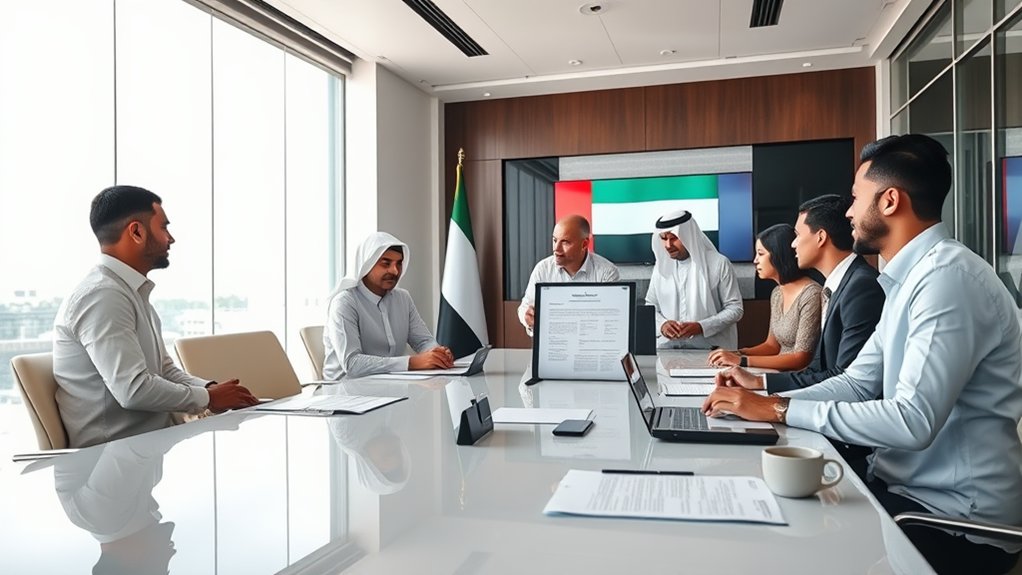
Once you've established your employee quota, you're ready to move on to the sponsorship process for foreign employees in the UAE. This process consists of two key phases: first, you'll apply for a work permit through the Ministry of Human Resources and Emiratisation (MoHRE), and then you'll obtain an employee work permit from immigration authorities. Required documentation includes a valid business license, an eSignature card, the employee's passport, and proof of their academic qualifications. Additionally, you'll need to provide a bank guarantee of AED 3,000 for each sponsored employee, ensuring they do not hold a valid work permit from another company. The Ministry will verify the availability of local nationals for the position before approving non-national employees, maintaining compliance with local labor regulations.
Financial Obligations for Employers
While hiring foreign employees in the UAE can enhance your workforce, it comes with specific financial obligations that you need to be aware of. Understanding these obligations is essential for maintaining a compliant status.
- You must cover all visa sponsorship costs, which include application fees and a bank guarantee of AED 3,000 per employee.
- Work permit issuance and renewal fees range from AED 250 to AED 3,450, contingent on your company's classification and compliance status.
- A refundable cash deposit of AED 2,500 per employee is required for sponsorship.
- Be prepared to pay fines of AED 20,000 for submitting incorrect data during the visa sponsorship process.
Compliance With Local Laws

Hiring foreign employees in the UAE requires strict adherence to local laws and regulations. You must guarantee your foreign branch holds a valid business license and complies with all local requirements before initiating sponsorship. The Ministry of Human Resources and Emiratisation (MoHRE) mandates a thorough review of local job seekers to confirm no UAE nationals are available for the position. Additionally, using the standard employment contract provided by MoHRE is crucial; both you and the employee must sign it, without adding extra clauses unless approved by the ministry. Compliance extends to paying a AED 3,000 bank guarantee per sponsored employee, essential for securing work permits. Non-compliance can result in severe penalties, including fines and potential revocation of your business license.
Job Title and Profession Alignment
Making certain that the job title and profession of your sponsored employee align with your company's registered activities is essential for compliance in the UAE. Misalignment can lead to permit rejection and increased scrutiny, impacting your operations. To maintain compliance with the Ministry of Human Resources and Emiratisation (MoHRE), consider the following:
- Confirm the job title matches the company's registered activities on the trade license.
- Verify the assigned profession on the work permit aligns with the employee's qualifications.
- Check that the job title corresponds with the standard employment contract descriptions.
- Be aware that local nationals must be prioritized for the position before hiring non-nationals.
Adhering to these guidelines will safeguard your company from penalties and promote smooth operations in the UAE.
Importance of Medical Fitness Tests

In the UAE, passing a medical fitness test is an essential step for foreign employees seeking work visas, as it guarantees compliance with health regulations aimed at safeguarding public health. This assessment not only evaluates communicable disease status but also serves as a critical component of employment eligibility, reinforcing the importance of preventive health measures within the workforce. By understanding the implications of these tests, you can better navigate the hiring process and secure a smoother change into your new role.
Health Clearance Requirement
Although you may be enthusiastic to start your new job in the UAE, passing a medical fitness test is essential for securing your work permit. This requirement guarantees you meet health standards and are free from communicable diseases. The medical examination takes place at an approved healthcare facility, and your results must accompany your work visa application. Here are key aspects of the medical fitness requirement:
- Screenings for diseases like HIV, tuberculosis, and hepatitis are mandatory.
- The medical fitness test is valid for only 30 days.
- Failing the test can lead to denial of your work permit.
- Successful completion is vital for your residency in the UAE.
Completing this process diligently will facilitate a smoother shift into your new role.
Employment Eligibility Assessment
Passing the medical fitness test is just one part of the broader employment eligibility assessment for foreign employees in the UAE. These tests are mandatory for obtaining employment visas, as they guarantee that prospective employees meet the stringent health standards necessary for residency and work permits. Medical fitness tests typically screen for communicable diseases such as HIV, tuberculosis, and hepatitis, critical for safeguarding public health. Conducted at approved healthcare facilities, the resulting medical report is an indispensable document in the work visa application process. Failing to pass can lead to denial of the work permit, adversely affecting foreign branches' ability to hire and sponsor employees. Additionally, since the medical fitness certification is valid for only 30 days, timely processing post-test is essential.
Preventive Health Measures
While securing a work permit in the UAE, understanding the importance of medical fitness tests is essential for both employers and prospective employees. These tests are critical for ensuring compliance with health standards mandated by the Ministry of Human Resources and Emiratisation. Consider these key points:
- Medical fitness tests assess for communicable diseases and overall health conditions.
- They must be conducted at authorized medical centers, ensuring reliability.
- Results are typically processed within a few days, facilitating timely work permit applications.
- Employees who do not pass these tests are ineligible for work permits, underscoring the essential role of health in the hiring process.
Handling Work Permit Violations
When you hire employees in the UAE, ensuring they have valid work permits is essential, as failing to do so can lead to severe penalties. Employers who violate work permit regulations face significant repercussions, including fines up to AED 20,000 for each unauthorized worker and, in cases of repeated offenses, potential revocation of their business licenses. The Ministry of Human Resources and Emiratisation (MoHRE) actively conducts compliance checks, and establishments engaged in unregistered activities may attract scrutiny. To mitigate risks associated with work permit violations, it's imperative that you maintain accurate records and adhere to the Wage Protection System, ensuring all documentation is submitted correctly and remains up-to-date. This diligence safeguards both your business and your employees.
Rights and Responsibilities of Employees

As an employee in the UAE, you have specific rights that are protected by labor laws, ensuring you receive timely salary payments and benefits like annual leave and health insurance. Your employer also has responsibilities, including providing a clear written contract that outlines your job terms and ensuring compliance with regulations. Understanding these rights and responsibilities is essential for fostering a fair and productive work environment.
Employee Rights Overview
In the UAE, employees enjoy a range of rights designed to protect their interests and guarantee fair treatment in the workplace. These rights, governed by UAE Labour Law, guarantee that you are treated fairly and with respect. Here are some key employee rights you should be aware of:
- You must receive a written employment contract within 7 days, detailing your position, salary, and working hours.
- After one year of service, you're entitled to a minimum of 30 days of annual leave, plus public holidays.
- End-of-service benefits are mandatory upon contract termination, calculated based on your basic salary and employment duration.
- Your salary payments should be made timely through the Wage Protection System (WPS), guaranteeing compliance with labor regulations.
Employer Responsibilities Explained
While employers in the UAE have specific responsibilities to guarantee a compliant and fair workplace, it's essential for you as an employee to understand your rights in this situation. Employers must secure a valid trade license and comply with labor laws, aligning employment contracts with Ministry of Human Resources and Emiratisation guidelines. They're responsible for covering costs associated with your visa requirements and work permit, which can vary considerably based on company classification. Additionally, employers must make certain you possess the necessary qualifications for your role and that you don't hold a work permit from another company. Maintaining timely salary records and providing health insurance are also crucial employer responsibilities mandated by UAE law, establishing a secure work environment for all employees.
Updates on Employment Regulations
With the recent updates to employment regulations in the UAE, it's essential for employers to stay informed about their obligations when hiring and sponsoring employees. Here are key points to contemplate:
- Your foreign branch must possess a valid business license and adhere to local labor laws before sponsoring employees.
- A standard employment contract is now mandatory, which must be signed by both parties without additional clauses unless approved by the Ministry of Human Resources and Emiratisation.
- Sponsorship costs, including a bank guarantee of AED 3,000 per employee and associated work permit fees, fall entirely on you as the employer.
- Prior to hiring foreign workers, you must secure entry visa quota approval and contemplate local nationals for job roles.
Understanding these employment regulations will facilitate smoother hiring processes in the UAE.
Frequently Asked Questions
Can a Company Sponsor Me to Work in the UAE?
Yes, a company can sponsor you for a work visa in the UAE. They'll need to follow UAE regulations, submit necessary documents, and guarantee compliance with employment sponsorship requirements to secure your position.
How Much Does It Cost to Sponsor an Employee in UAE?
Sponsoring an employee in the UAE involves various costs. You'll face sponsorship fees, visa costs, and employment expenses, totaling anywhere from AED 3,000 to AED 20,000, depending on your company's classification and requirements.
How Can a Foreigner Get a Job in UAE?
To get a job in the UAE, utilize effective job search strategies and employment agencies. Make sure you understand the work visa requirements, including job offers, medical tests, and valid qualifications for a smoother process.
Which Companies Sponsor Visa in the UAE?
In the UAE, eligible companies such as public, private, and branch offices can sponsor visas. They must meet sponsorship requirements and submit applications for various visa types, ensuring compliance with local labor laws.
Conclusion
Maneuvering the intricacies of hiring and sponsoring employees in the UAE can feel like traversing a labyrinthine landscape. By understanding the essential business licensing requirements, eligibility criteria, and the work visa application process, you can effectively position your foreign branch for success. Adhering to regulatory updates and ensuring compliance with employment standards will not only safeguard your interests but also foster a harmonious workplace environment. Ultimately, diligence in these areas is paramount to achieving operational excellence in this dynamic market.